
Category: Childcare Options & Comparisons

  • In-Home Babysitting vs Nursery: What’s the Difference

    For a lot of parents, the choice between in-home babysitting and nursery care isn’t really about which one is “better”, it’s about which one fits the shape of your week, your child’s personality, and what you need care to actually do for you. Both can be excellent, and both suit different families for different reasons. This guide breaks down the real differences, so you can work out which setup makes sense for your household rather than going with whichever one everyone else seems to be using.

    The Core Difference: Environment

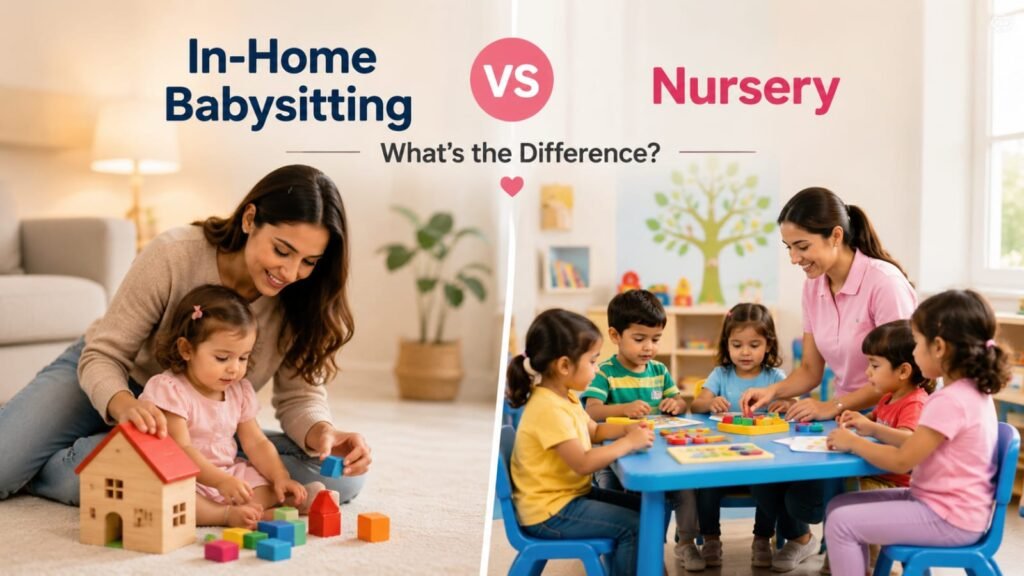
    The most obvious difference between the two is where care actually happens, and that shapes almost everything else about the experience. In-home babysitting means your child stays in their own familiar space, surrounded by their own toys, their own bed, and their own routine, with one carer giving them individual attention. Nursery care moves your child into a shared environment with other children their age, structured activities, and a rotating team of staff rather than a single consistent carer. Neither setting is inherently better, but they do suit different children. A child who settles quickly, enjoys company, and thrives on structure often does well in a nursery setting. A child who’s more sensitive to change, doesn’t sleep well outside their own space, or needs a slower pace of introduction to new people often does better with in-home care, at least at first.

    Routine and Flexibility

    This is where the two options tend to pull in opposite directions. Nurseries run on a fixed schedule, with set opening and closing times, set days, and a structure that doesn’t flex around your week. That’s genuinely useful if your own schedule is steady and predictable, because you always know exactly what’s covered and when. In-home babysitting works the other way around, built around your hours rather than a fixed timetable. If your work pattern changes week to week, if you need occasional evening or weekend cover, or if your child’s own routine needs to be protected as closely as possible, a babysitter can adapt in a way a nursery generally can’t. Families with unpredictable schedules, shift work, or frequent late finishes often find in-home care fits the reality of their week far better than trying to bend a nursery’s hours around it.

    One-to-One Attention vs Social Exposure

    A nursery’s biggest strength is also its defining feature: your child is one of many, not the only one being looked after. That means constant exposure to other children their age, shared play, group activities, and the early social skills that come from navigating a room full of peers, taking turns, sharing space, and building friendships outside the family. An in-home babysitter offers the opposite strength, undivided one-to-one attention. There’s no splitting focus between multiple children, no waiting your turn for a nappy change or a snack, and far more scope for a carer to follow your child’s own pace and interests through the day. For very young babies, children with additional needs, or children going through a period of separation anxiety, that one-to-one attention can matter more than social exposure, at least for a while. For toddlers and older children building social confidence, the group setting of a nursery often becomes the more valuable piece.

    Illness and Exposure

    This is a practical difference that catches a lot of parents out. Nurseries, simply by having lots of children in one shared space, tend to see more frequent minor illnesses circulating, colds, stomach bugs, and the usual run of things that spread quickly among young children in close contact. It’s not a reflection of a nursery doing anything wrong, it’s just what happens when groups of children share a room. In-home babysitting doesn’t eliminate illness, but with one child and one carer, there’s far less day-to-day exposure to other children’s colds and bugs. For families with a child who has a compromised immune system, or simply parents who are tired of the near-constant nursery bug cycle familiar to anyone with a toddler in daycare, this is often a real factor in the decision, not a minor one.

    Cost and Value

    Cost comparisons between the two aren’t always straightforward, because you’re not just paying for hours, you’re paying for a different kind of care. Nursery fees are usually structured around set days or sessions, often with early booking discounts or funded hours depending on your child’s age and where you live. In-home babysitting is typically priced by the hour, which can work out more cost-effective for occasional or part-time cover, but adds up quickly if you need full-time, five-day-a-week care. As a rough rule, nurseries tend to offer better value for consistent, full-time attendance, while in-home babysitting tends to offer better value for flexible, occasional, or short-notice cover. It’s worth actually running the numbers against your specific week rather than assuming one is automatically cheaper than the other.

    Which One Actually Fits Your Family

    There’s no single right answer here, because the right choice depends on your child, your schedule, and what you need care to do. A predictable working week, a child who enjoys group settings, and a need for consistent full-time cover often points toward a nursery. An unpredictable schedule, a younger baby, a child who needs more individual attention, or a need for occasional and flexible cover often points toward in-home babysitting. Plenty of families also use both, nursery for the structured weekdays, and an in-home babysitter for evenings, weekends, or the gaps a nursery’s fixed hours can’t cover.

    At Babies Care Hub, our carers are experienced in exactly this kind of flexible, in-home support, whether that’s filling the hours around a nursery schedule or providing full one-to-one care on its own.

    Frequently Asked Questions

    Is in-home babysitting or nursery better for a baby under one? Many parents find one-to-one in-home care suits very young babies well, since it protects sleep and feeding routines closely, though this depends entirely on the individual baby and family.

    Can I use both a nursery and an in-home babysitter? Yes, this is common, with a nursery covering set weekdays and a babysitter filling evenings, weekends, or short-notice gaps.

    Does in-home babysitting offer less social interaction than nursery? It offers less group interaction with same-age peers, though playgroups, classes, or family visits can help build in social time alongside in-home care.

    Is a babysitter more expensive than a nursery? It depends on how many hours you need. Babysitting is often more cost-effective for part-time or flexible cover, while nurseries tend to offer better value for consistent full-time attendance.

    How do I know which option suits my child? Consider your child’s temperament, how they handle new environments and people, and how predictable your own weekly schedule is, all of which point toward one option or the other.

    Do Babies Care Hub babysitters follow the same routine as a nursery would? Yes, our carers work around your child’s existing routine, whether that’s naps, meals, or bedtime, keeping things consistent even outside a nursery setting.

    Neither option is a universal answer, and the right one is simply whichever fits your child and your week more closely right now, knowing that can always change as your circumstances do. If you’re weighing up your options, Book a Babysitter with Babies Care Hub, or get in touch via Contact Us and our team can help you think through what suits your family best.